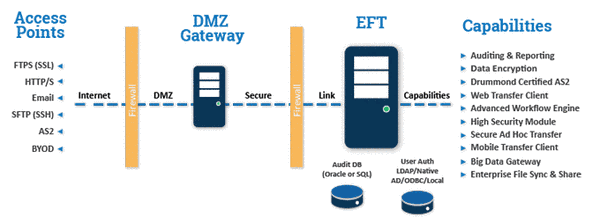
Captures all transactions and events in EFT and stores them in real time in a relational database, enabling fast searching, analysis, and reporting. Ideal for troubleshooting, compliance/non‑repudiation, and internal accountability (e.g., billing or trend analyses), with both preconfigured reports and the ability to design your own.
For process automation: build advanced workflows using drag‑and‑drop (no code) and link them directly to EFT Event Rules. Replace scripts and batch jobs with reusable automation and integrations, with a broad set of actions for end‑to‑end file transfer orchestration.
Strengthens your perimeter by allowing EFT to operate securely in a multi-layer DMZ setup: the DMZ Gateway acts as a proxy/communications bridge without requiring you to open inbound (west→east) holes through your firewall. This reduces complexity, lowers failure points, and can make data available in real time to back-end systems.
Enables browser-based file transfers via HTTP/HTTPS without needing to deploy a separate web server: users work simply through their browser. HTTPS encrypts the session (TLS/SSL), making it suitable for secure exchange with customers/partners with minimal client requirements.
Adds OpenPGP encryption for data (strong public-key plus symmetric cryptography), including encrypt/sign/decrypt/verify and support for digital signatures. This secures files not only “in transit,” but also at rest, where PGP is often a hard requirement in partner chains.
A browser-based file transfer client that lets users upload/download via HTTPS and perform basic file management (such as managing folders, pausing/resuming transfers, and sharing). Low-friction for external partners: works in modern browsers and requires little to no client administration.
Enables secure exchange with supply-chain partners via AS2, widely used for EDI (but also suitable for other file types). AS2 manages the entire process of connecting, delivering, validating, and handling acknowledgements, using a secure “envelope” over HTTP/HTTPS and clear verification/reporting per transmission.
A web-based (self-service) dashboard that gives both IT and business users real-time insight into file transfers and transaction statuses, including drill-down to detail. This results in fewer “where is my file?” tickets and more control over processes by department/procedure.
For organizations with stringent requirements: raises the security level with, among other things, stricter account/password policies, support for FIPS-compliant protocols/ciphers, and monitoring/auditing of configuration changes toward a less secure state. Helps demonstrate controls for standards such as PCI DSS, HIPAA, SOX, and ISO-like frameworks.
A mobile client/app for secure access to files on EFT from mobile devices (BYOD), focused on productivity while keeping corporate data within organizational boundaries. Useful for teams that need to securely upload/download while on the move.
Supports SFTP/SSH for platform-independent, encrypted file transfer with, among other things, password and public-key authentication, key management, and extensive logging. Often requested by partners as the “secure FTP” standard and helps meet security/compliance requirements for data transport.